
Gion Matsuri 2027, Hour by Hour: Where to Stand on 17 July
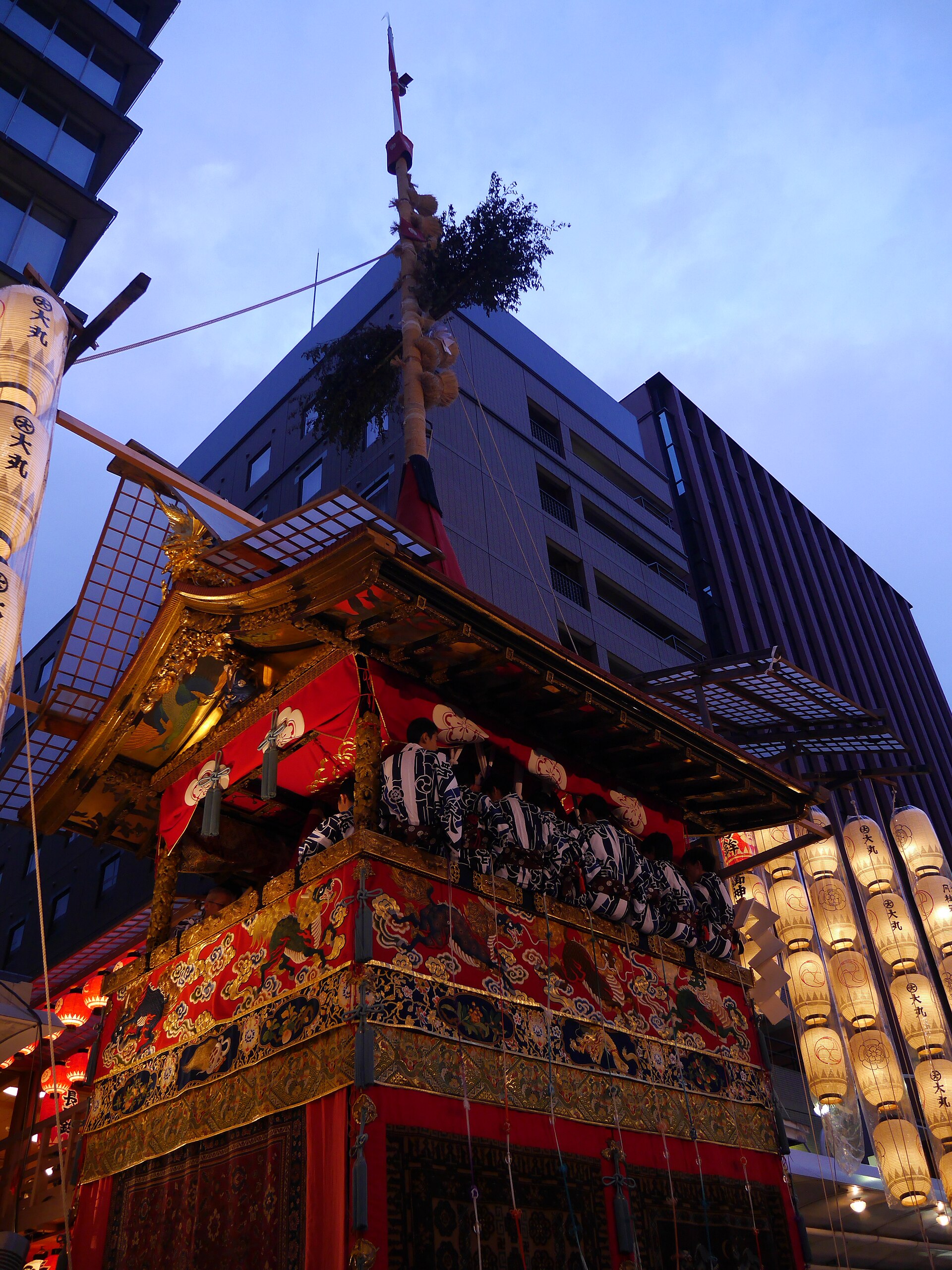
Gion Matsuri 2027 peaks on Saturday 17 July 2027, when 23 floats leave Shijo-Karasuma at 9:00 and reach the first big corner turn at Shijo-Kawaramachi at about 9:35. To see that turn from the front, be on the kerb by 8:00; if you would rather sit, book a paid seat on Oike-dori, where the lead float arrives at about 10:30.
This guide is the hour-by-hour version: the July programme with 2027 weekdays, the three Yoiyama nights, the timed route, where to stand at each point, what the paid seats cost in 2026 and when the 2027 seats should go on sale, plus how to survive the heat and find a bed. For every other festival of the year, see our Japanese festival calendar. Everything here was checked between 19 and 21 October 2026.
Sat 17 Jul 2027
Saki Matsuri parade, 9:00
Sat 24 Jul 2027
Ato Matsuri parade, 9:30
From ¥6,000
Paid seat, 2026 price
32.0°C
Average July high in Kyoto
When is Gion Matsuri 2027?
Gion Matsuri runs for the whole of July, from the opening rites on 1 July to the closing ceremony at Ekijinja on 31 July. The dates are fixed by tradition, not by weekday, so the 2027 calendar can be set now. The big change for 2027: both parade days fall on a Saturday, so expect weekend crowds on top of the usual summer crush.
| Date (2027) | What happens | Time |
|---|---|---|
| Thu 1 Jul | Kippu-iri: the float neighbourhoods open the festival | Through the day |
| Sat 10 – Tue 13 Jul | Hoko-tate: the Saki Matsuri floats are assembled by hand | Daytime |
| Sat 10 Jul | Mikoshi-arai: the main portable shrine is purified | 20:00 |
| Wed 14 – Fri 16 Jul | Saki Matsuri Yoiyama: lanterns, festival music and open houses | From early evening |
| Sat 17 Jul | Saki Matsuri Yamahoko Junko: 23 floats | 9:00 from Shijo-Karasuma |
| Sat 17 Jul | Shinkosai: three mikoshi gather at Yasaka Shrine’s west gate, then head for the Shijo-Teramachi otabisho | 16:00 ceremony, 18:00 departure |
| Wed 21 – Fri 23 Jul | Ato Matsuri Yoiyama: quieter, no street stalls | From early evening |
| Sat 24 Jul | Ato Matsuri Yamahoko Junko: 11 floats, plus the Hanagasa parade | 9:30 from Karasuma-Oike |
| Sat 24 Jul | Kankosai: the mikoshi return to Yasaka Shrine | Back around 23:00 |
| Sat 31 Jul | Ekijinja Nagoshi-sai: closing rite | 10:00 |
Dates and times are from Yasaka Shrine’s festival schedule and the Kyoto City Tourism Association (KCTA). The days are fixed every year; the clock times are the 2026 ones, which barely move from year to year. Both organisers call the times approximate.
What happens on the Yoiyama nights?
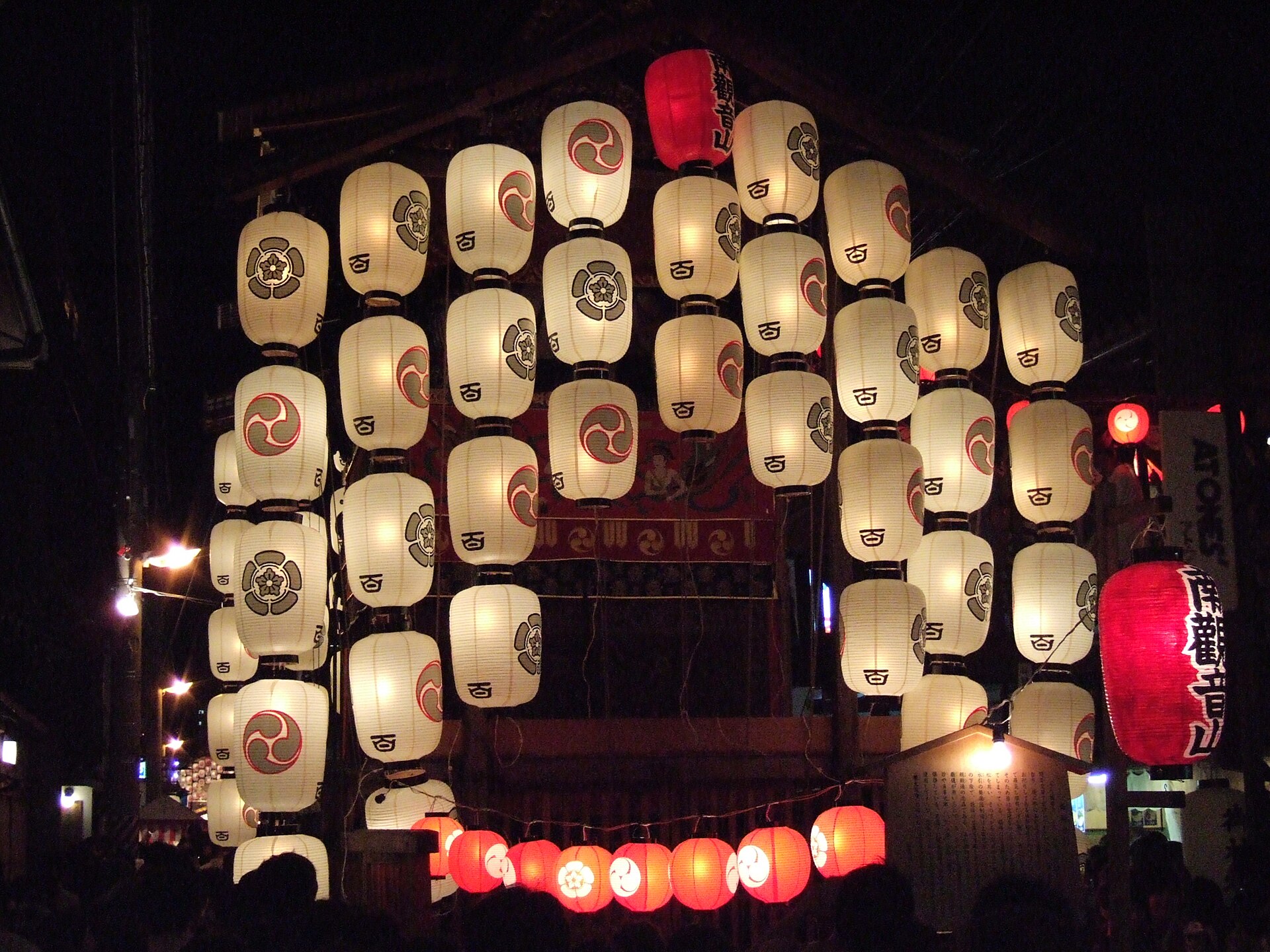
Yoiyama means the evenings before a parade. The floats stand fully dressed in their home streets, lanterns lit, while musicians on board play the “kon-chiki-chin” festival music. This is when Kyoto locals actually go to Gion Matsuri; the parade is more of a visitor event.
- 14 July is the calm night. KCTA itself says the 14th is relatively relaxed. Kyoto City’s 2026 guide also notes there are no street stalls that night, so it is about the floats, not the food.
- 15 and 16 July are the crush. Parts of Shijo-dori and Karasuma-dori go car-free from about 18:00 to 23:00 and the stalls come out. On 16 July 2026, Kyodo described central Kyoto as “overflowing” with people.
- 21–23 July (Ato Matsuri Yoiyama) has no stalls at all, per the city guide. Fewer people, more atmosphere, better photos.
- Go before dark. KCTA’s own tip is to arrive before sunset to see the floats properly.
Three things worth doing: buy a chimaki, the bamboo-leaf charm against disease and bad luck sold at each float; look into the old townhouses that open their rooms to show folding screens (the “byobu matsuri”); and climb a float. KCTA confirms that some floats let visitors board on Yoiyama evenings; rules and fees vary by float and are not published centrally, so ask at the float. The official digital Yoiyama map shows where each one stands.
Gion Matsuri on 17 July: the parade hour by hour
The Saki Matsuri route is a loop of about three sides of a rectangle: east along Shijo-dori, north up Kawaramachi-dori, west along Oike-dori, then south down Shinmachi-dori. These are the 2026 scheduled times for the lead float (Naginata-boko) from KCTA; the tail is about two hours behind.
| Time (lead float) | Where | What you see |
|---|---|---|
| 9:00 | Shijo-Karasuma | Departure. Naginata-boko, carrying the chigo (a boy chosen as the sacred page), leads off |
| After 9:00 | Shijo-Sakaimachi | Kuji-aratame: each float’s place in the order is checked against the lots drawn on 10 July |
| About 9:35 | Shijo-Kawaramachi | First tsuji-mawashi (corner turn) |
| About 10:20 | Kawaramachi-Oike | Second tsuji-mawashi, by City Hall |
| About 10:30–11:20 | Oike-dori (Kawaramachi to Shinmachi) | The paid seating zone |
| About 11:20 | Shinmachi-Oike | Third and last tsuji-mawashi, then the floats head home down Shinmachi |
| 16:00 and 18:00 | Yasaka Shrine | Shinkosai: the three mikoshi gather under the west gate at 18:00 |
The whole Saki Matsuri parade takes about two hours to pass any one point, so a lead-float time of 10:20 means the last float comes through after noon. KCTA’s seat FAQ gives the same two-hour figure for the seating zone.
Where should you stand to watch Gion Matsuri?
There is no single best spot, only trade-offs between drama, shade and how early you can face getting up. Here is how each point compares on a Saturday in July.
| Spot | Lead float | Why go | Catch | Arrive by |
|---|---|---|---|---|
| Shijo-Karasuma | 9:00 | See the chigo cut the rope; closest to Shijo and Karasuma stations | No turn; very tight pavements | 7:00 for the front |
| Shijo-dori between Karasuma and Kawaramachi | 9:05–9:30 | Long straight, floats pass between shopfronts; easy to slip out | No turns | 8:00 |
| Shijo-Kawaramachi | About 9:35 | The first and most-photographed corner turn | The busiest spot on the route | 8:00 at the latest |
| Kawaramachi-dori (Shijo to Oike) | 9:40–10:20 | Wide pavements under arcades with some shade | Floats pass quickly | 8:30 |
| Kawaramachi-Oike | About 10:20 | Second turn, slightly calmer than Shijo | Seats take the south-west corner | 9:00 |
| Shinmachi-Oike | About 11:20 | Final turn; morning crowds have thinned | Late, hot, last floats after 13:00 | 10:00 |
Arrive-by times are our advice, not official guidance. With both 2027 parade days on a Saturday, add half an hour if you want the kerb. If you only have one morning, the best combination is the corner at Shijo-Kawaramachi at 9:35, then a walk north up the Kawaramachi arcades to catch the last floats turning into Oike-dori.
Our 17 July plan, minute by minute
- 7:45 Pick up water and onigiri at a convenience store, then walk to Shijo-Kawaramachi.
- 8:00 Claim a spot on the kerb at the corner. Hat on, phone charged.
- 9:35 The lead float reaches the first turn. Watch three or four floats come round, which takes a while.
- About 10:15 Walk north up Kawaramachi-dori under the arcades. It is roughly 1 km, so you can overtake the floats and catch more turns at Kawaramachi-Oike.
- Noon Retreat indoors for lunch and air conditioning. The tail of the parade is still turning at Shinmachi-Oike into the early afternoon.
- 18:00 Be at Yasaka Shrine’s west gate, where the three mikoshi gather for the evening procession.
What is a tsuji-mawashi corner turn?
A hoko weighs about 12 tonnes and stands about 25 metres from the ground to the tip of its spire, per KCTA. It has fixed wooden wheels and no steering. To turn a corner, the crew lays split bamboo on the road, wets it, and the pullers drag the float round in jerks of a few degrees at a time, cued by fan-waving leaders standing on the front.
Each turn takes several minutes and usually a few attempts. That is the show. On the Saki Matsuri route there are three: Shijo-Kawaramachi, Kawaramachi-Oike and Shinmachi-Oike. Shinmachi-dori is narrow, so the last turn is the tightest squeeze of the day.
How do the Gion Matsuri paid seats work?
KCTA runs reserved seating on Oike-dori. All seats are numbered, the front row is row A, and you cannot pick your block. These are the 2026 prices from KCTA’s seat page, tax included, with a guidebook, a tote bag and heat-protection goods.
| Seat (2026) | Front row | Row 2 and back | Notes |
|---|---|---|---|
| General (17 Jul) | ¥8,000 | ¥6,000 | Oike-dori, Kawaramachi to Shinmachi; blocks 1–24 |
| Manabi “learning” seat (17 Jul) | ¥11,500 | ¥9,500 | Japanese commentary to your phone |
| Special manabi seat (17 Jul) | ¥14,500 | ¥12,500 | In front of City Hall; Japanese and English commentary |
| Premium (17 Jul) | ¥125,000 | ¥155,000 (rows 2–3) | Rows 2–3 add parasol, cushion, table and drinks holder |
| General (24 Jul) | ¥8,000 | ¥6,000 | Karasuma–Takakura and Teramachi–Kawaramachi stretches |
| Special manabi seat (24 Jul) | ¥14,500 | ¥12,500 | Japanese and English commentary |
Commentary streams to your own phone through a browser, so bring earphones and mobile data. In the seats, the lead float passes from about 10:30 (Kawaramachi-Oike end) to 11:20 (Shinmachi-Oike end) on the 17th, and from 9:30 to 9:50 on the 24th. KCTA asks you to be seated 30 minutes before the lead float is due; latecomers who cannot get through the crowds get no refund.
When do 2027 seats go on sale?
KCTA had not announced 2027 seat sales when we checked between 19 and 21 October 2026. For reference: in 2026, group sales (10 or more) opened by lottery from 30 January, and general sales began on Monday 1 June 2026 at 10:00. In 2024 the general sale started on 11 June. So expect individual seats in late spring 2027, and watch the KCTA seat page from April.
- Where to buy: Ticket Pia online (free member registration, Japanese) or at 7-Eleven stores with a P-code. Fees follow Pia’s rules.
- Limit: 9 tickets per transaction; bigger parties may not sit together.
- No cancellations once paid. Refunds only if the parade is cancelled, and fees are not returned.
- Rain or shine. Umbrellas, parasols and tripods are banned in the seats; bring a raincoat and a hat. No smoking, no alcohol.
- No child or senior discounts. Wheelchair seats cost the same and sit near a lift and accessible toilet.
The seat page is Japanese only. That is exactly the kind of form we deal with for you.
Is the Ato Matsuri on 24 July worth it?
Yes, if you dislike crowds. Eleven floats run the route in reverse: they leave Karasuma-Oike at 9:30, pass Kawaramachi-Oike at about 10:00, turn at Shijo-Kawaramachi at about 10:40 and finish near Shijo-Karasuma at about 11:20, per KCTA. The lot check happens in front of City Hall. KCTA puts the viewing time at about one hour.
The same morning brings the Hanagasa parade, a procession of flower-hatted dancers and musicians, and that night the mikoshi make their way back to the shrine, arriving around 23:00. It makes a full, less frantic day.
How do you cope with the Kyoto heat in July?
Kyoto’s average daily high in July is 32.0°C, with a night-time low of 23.6°C, per the Japan Meteorological Agency’s 1991–2020 normals. Kyoto sits in a basin, so the humidity hangs. Recent Julys have regularly been hotter than those averages.
- Wear a hat; parasols are banned in the seats and frowned on in the crowd because they block views.
- Carry two drinks. Kyoto City set up bottle-refill stations on 15–16 July 2026; vending machines on the route sell out.
- Freeze a bottle overnight and wrap it in a small towel for your neck.
- Pick a spot with shade: the Kawaramachi-dori arcades help; the open stretches of Oike-dori do not.
- Plan toilet breaks. KCTA warns that toilets near the seats are limited, so use station or convenience-store toilets before you settle in.
Where should you stay for Gion Matsuri?
Stay on the Karasuma subway line or the Hankyu line and you can walk to every point on the route. Shijo (Karasuma Line), Karasuma and Kyoto-Kawaramachi (Hankyu), Gion-Shijo (Keihan) and Kyoto Shiyakusho-mae (Tozai Line) all serve the festival area, per the city’s 2026 guide. Bicycles are not allowed in the festival zone.
Book now. Rooms near Shijo-Karasuma for 16–17 July 2027, a Friday and Saturday, will go first. If central Kyoto is full or silly money, look at Osaka: the Hankyu and Keihan lines both run straight into the festival area. Our Gion-Shijo station guide covers the east end of the route in detail.
Budget for Kyoto’s accommodation tax, which rose on 1 March 2026. It is charged per person, per night, by room rate (excluding meals and consumption tax), per Kyoto City:
| Room rate per person per night | Tax |
|---|---|
| Under ¥6,000 | ¥200 |
| ¥6,000 to under ¥20,000 | ¥400 |
| ¥20,000 to under ¥50,000 | ¥1,000 |
| ¥50,000 to under ¥100,000 | ¥4,000 |
| ¥100,000 and over | ¥10,000 |
Coming from Tokyo? JR Central’s Nozomi reserved fares rise for tickets bought from 1 July 2027, so buy your Shinkansen ticket in June. Details are in our Shinkansen fare increase guide. Flying in to Osaka? Here is how to get from Kansai Airport to Kyoto.
Know before you go
Umbrellas are out
The parade goes ahead in rain, and umbrellas and parasols are banned in the seats. Pack a light raincoat.
Saturdays in 2027
Both parade days fall on a Saturday in 2027. Arrive 30 minutes earlier than you would for a weekday.
14 July for photos
The first Yoiyama night is calmer and stall-free, so the floats are easier to see.
Ato Matsuri for space
The 24 July parade is shorter, quieter and still has the corner turn at Shijo-Kawaramachi.
Quiet, please
KCTA asks seat-holders to stay quiet during the parade and avoid flashy outfits. Yukata are fine.
No smoking on the street
Smoking on the street is banned in central Kyoto’s designated areas, with a ¥1,000 fine.
How do you get to the parade route?
Take the train. On parade mornings central Kyoto is closed to traffic and taxis are no use. From Kyoto Station, the Karasuma subway line reaches Shijo in a few minutes; for the seats, ride on to Karasuma-Oike or switch to the Tozai Line for Kyoto Shiyakusho-mae. Have an IC card topped up so you are not queuing at ticket machines with everyone else.
Gion Matsuri FAQ
When is Gion Matsuri 2027?
All of July 2027. The main parade (Saki Matsuri) is Saturday 17 July 2027 from 9:00, and the second parade (Ato Matsuri) is Saturday 24 July 2027 from 9:30. Yoiyama nights are 14–16 and 21–23 July.
What time does the Gion Matsuri parade start?
The 17 July parade leaves Shijo-Karasuma at 9:00. The 24 July parade leaves Karasuma-Oike at 9:30. Times are the 2026 schedule from the Kyoto City Tourism Association.
Where is the best place to watch the Gion Matsuri parade?
For the classic corner turn, Shijo-Kawaramachi at about 9:35; be there by 8:00. For a calmer view, Kawaramachi-Oike at about 10:20 or Shinmachi-Oike at about 11:20.
How much are the paid seats for the parade?
In 2026, general seats cost ¥6,000 (row 2 and back) or ¥8,000 (front row). Seats with English commentary cost ¥12,500–¥14,500, and premium seats ¥125,000–¥155,000.
When do Gion Matsuri 2027 seats go on sale?
Not yet announced. In 2026 general sales opened on 1 June at 10:00 through Ticket Pia and 7-Eleven, so expect late spring 2027.
Does the parade go ahead in the rain?
Yes. The parade is held rain or shine. Umbrellas are banned in the paid seats, so bring a raincoat.
Can you climb on the floats?
Some floats let visitors board during the Yoiyama evenings. Rules and fees vary by float, so ask at the float itself.
Is the 24 July Ato Matsuri parade worth seeing?
Yes, if you want fewer crowds. It has 11 floats, runs the route in reverse and takes about an hour to pass.
Sources and how we checked
Every date, time, price and rule here was checked between 19 and 21 October 2026 against the linked official sources: the Kyoto City Tourism Association’s Gion Matsuri pages, Yasaka Shrine, Kyoto City and the Japan Meteorological Agency. 2027 times are based on the 2026 schedule because the 2027 programme has not been published; we will update this page when it is.
Want Gion Matsuri sorted?
Japan Pro can book your parade seats, your Kyoto room and a guide for Yoiyama night, even when the forms are Japanese only.
 English
 Japanese
 Chinese (Taiwan)
 Chinese (China)
 Korean
 French
 Italian
 Thai