
Yanaka Ginza 2026: A One-Day Walk Through Yanaka, Sendagi and Nezu
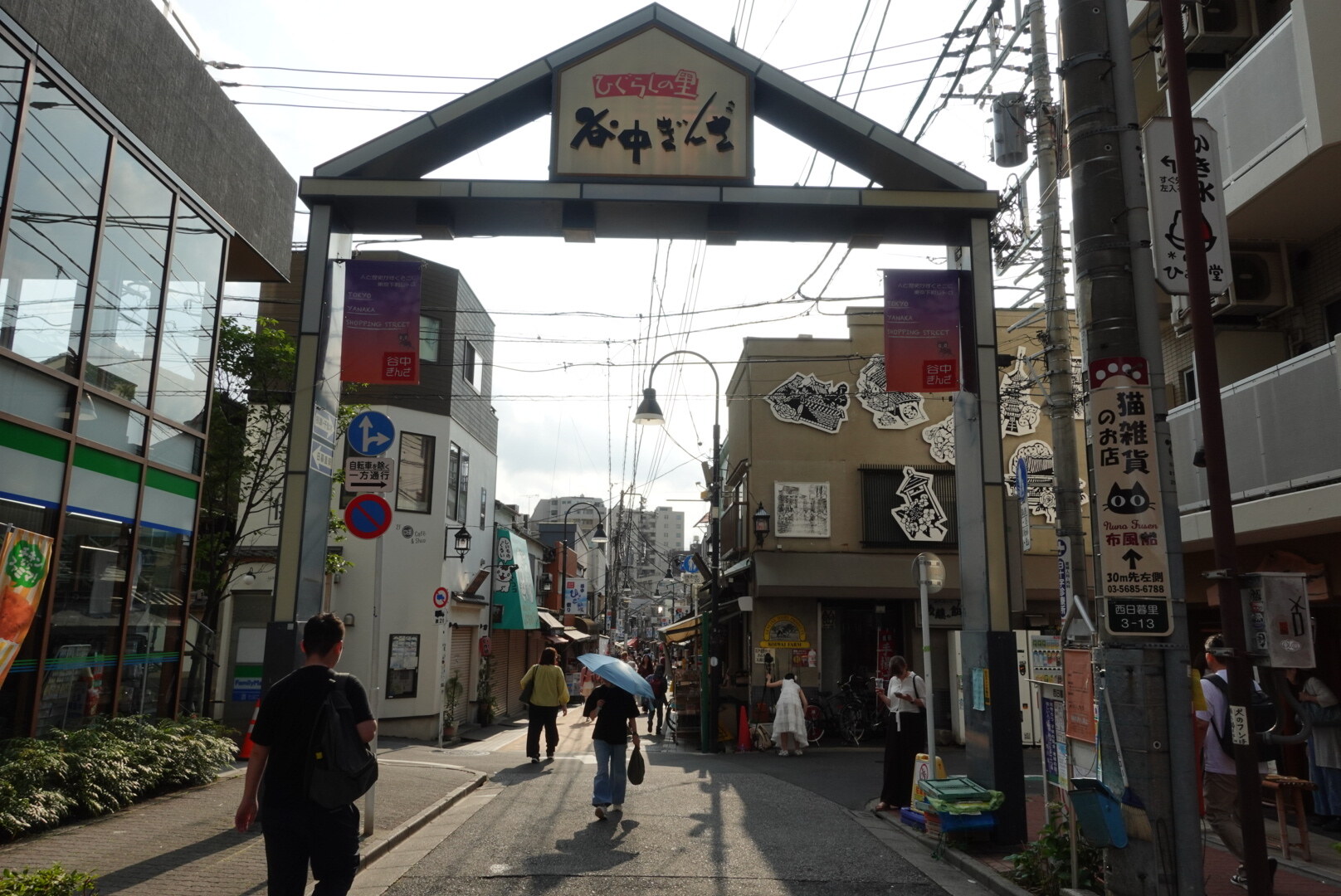
Yanaka Ginza is a 170-metre shopping street of about 70 small family shops in northeast Tokyo, five minutes’ walk from Nippori Station. The air raids of the Second World War missed this corner of the old city, and later redevelopment never reached it, so you still buy croquettes from a butcher who sells to the neighbours.
This guide turns the street into a full day across Yanaka, Sendagi and Nezu, the area locals call Yanesen. It is a timed walking route from Nippori to Ueno with every stop on the way: a 17th-century bronze Buddha, the cemetery where the last shogun lies, a sculptor’s house, the cat shops, a paper shop from 1864 and one of Tokyo’s finest shrines. Every opening time and price was checked between 19 and 21 October 2026.
170 m
Length of Yanaka Ginza
About 70
Shops on the street
¥500
Asakura Museum entry
1706
Nezu Shrine buildings

Is Yanaka Ginza worth visiting?
Yes, if you want ordinary Tokyo rather than another landmark. It is a working street, it costs nothing to walk, and three hours covers the core of it. Add Nezu and Sendagi and it becomes one of the best low-cost days in the city.
Do not expect Asakusa. There are no big temples to queue for and no souvenir arcades. The pleasure is in the small things: fried food eaten standing, wooden houses, quiet temple lanes and a lot of cats, most of them made of ceramic. If you like this kind of neighbourhood, our Tokyo hidden gems list has more.
How do you get to Yanaka Ginza, and which station should you use?
Three stations serve the area. Start at Nippori and finish at Nezu or Ueno, and you never walk the same street twice.
| 最寄り駅 | Lines | Use it for |
|---|---|---|
| Nippori | JR Yamanote, Keihin-Tohoku and Joban; Keisei (incl. Skyliner); Nippori-Toneri Liner | Tennoji, Yanaka Cemetery, Asakura Museum, the top of the shopping street |
| Sendagi | Tokyo Metro Chiyoda | The bottom of the shopping street; Isetatsu (Dangozaka exit) |
| Nezu | Tokyo Metro Chiyoda | Nezu Shrine, Kamachiku, Hantei |
Nippori is about 20 minutes from Shinjuku and 30 minutes from Shibuya on the Yamanote Line. Take the west exit. Yanaka Cemetery is a five- to six-minute walk from there, according to the Tokyo Metropolitan Park Association.
Flying into Narita? The Keisei Skyliner stops at Nippori before Ueno. An adult ticket from the airport costs ¥1,280 fare plus a ¥1,300 Skyliner charge, so ¥2,580 in total (¥1,267 fare by IC card), per Keisei. Drop your bags at the hotel and you can be on this walk the same afternoon.
The Yanaka walking route at a glance
This is the full-day version, starting at 10:00. It is all on foot, with plenty of stops. The times assume an easy pace and a long grazing lunch.
| Time | Stop | Area | Cost |
|---|---|---|---|
| 10:00 | Nippori west exit | Nippori | – |
| 10:05 | Tennoji and the Genroku Buddha | Yanaka | 無料 |
| 10:25 | Yanaka Cemetery | Yanaka | 無料 |
| 11:10 | Asakura Museum of Sculpture | Yanaka | ¥500 |
| 12:10 | Yuyake Dandan and the shopping street (lunch) | Yanaka | ¥1,000–¥2,000 |
| 13:10 | Cat shops: Yanakado and Cafe Nekoemon | Yanaka | Free to browse |
| 13:40 | Isetatsu paper shop | Sendagi | Free to browse |
| 14:10 | Nezu Shrine | Nezu | 無料 |
| 15:00 | Kamachiku udon, or a snack | Nezu | From about ¥1,000 |
| 16:00 | SCAI THE BATHHOUSE and Kayaba Coffee | Yanaka 6-chome | Coffee |
| 17:00 | 上野恩賜公園 | Ueno | 無料 |
Short on time? The classic three-hour version skips the museum, Sendagi and Nezu: Nippori, Tennoji, the cemetery, the shopping street, the cat shops and Kayaba Coffee, then Ueno Park.
10:05 – Tennoji: why is there a Buddha outdoors?
Leave Nippori by the west exit and Tennoji is straight ahead. It is quiet, green and almost always empty. Its main sight is the Genroku Buddha, a seated bronze Shaka Buddha cast in 1690 by Ota Kyuemon of Kanda. It is 296 cm tall and sits under the trees rather than inside a hall, per Tabi-Mag.
The temple has had several lives. It began as a Nichiren temple called Kannoji, was converted to the Tendai school under the shogunate, and took the name Tennoji in 1833. In the Edo period it was famous for its tomikuji lottery, one of the three big lotteries of Edo, according to Kotobank.

10:25 – Yanaka Cemetery: what should you look for?
Walk south from Tennoji and the temple grounds open into Yanaka Cemetery. It is more park than graveyard: wide avenues, cherry trees along the central path, and stone markers going back to the Edo period. Locals walk dogs and cut through it on the way to the station, so you are not intruding.
The cemetery opened on 1 September 1874 and covers about 10 hectares (102,537 m²), per the Tokyo Metropolitan Park Association. Painters, writers and actors are buried here.
- The last shogun. Tokugawa Yoshinobu, the fifteenth and final Tokugawa shogun, is buried here.
- The pagoda site. The site of Tennoji’s five-storey pagoda is inside the cemetery. The pagoda was the model for Koda Rohan’s novel Gojunoto (The Five-Storied Pagoda).
- Cherry avenue. In late March and early April the central path becomes a tunnel of blossom. It is busy then, but without the crowds of Ueno.
Be respectful: no picnics on the graves, keep your voice down and stay on the paths.

11:10 – Asakura Museum of Sculpture: is it worth ¥500?
Yes, and most visitors walk straight past it. This was the home and studio of sculptor Fumio Asakura, a concrete studio joined to a Japanese house built around a water garden, with a rooftop garden on top.
| Asakura Museum | Details (2026) |
|---|---|
| Hours | 9:30–16:30, last entry 16:00 |
| Closed | Mondays and Thursdays (open if a public holiday) |
| Entry | ¥500 adults; ¥250 school students |
| Extra closures | Late Oct: 22, 26, 29. November: 2, 5–12, 16, 19, 24, 26, 30 |
The extra closures are for exterior painting and may change, so check the museum website before you go. Hours and fees are from the National Art Center’s Art Commons listing. You take your shoes off at the entrance: wear socks without rubber grips, because the floors are lacquered. The building is not step-free, and the rooftop can close in bad weather.
12:10 – Yuyake Dandan and Yanaka Ginza: what should you eat?
From the museum, walk west to the top of Yuyake Dandan, the “sunset steps”. They lead down to the entrance of the shopping street and are named for the sunsets you see from the top, facing west. It is the photo stop of the area.

Below, the street runs flat for 170 metres under a low arch. There are craft shops, a butcher, tea sellers, sweet shops and standing-food stalls. Work down one side and back up the other, buying one thing at a time.
- Niku no Suzuki: the butcher’s menchi-katsu, a minced-meat cutlet fried to order.
- Yanaka Shippoya: cat-tail doughnuts, twisted and sugared, in about a dozen flavours.
- Waguriya: chestnut sweets, including a Mont Blanc soft-serve.
- Echigoya Honten: a liquor shop and standing bar that has traded since 1904, according to Time Out Tokyo.
- Kamenoko Tawashi: scrubbing brushes from a maker in business since 1907. A good small, useful souvenir.
Bring cash. Many stalls are small family businesses that do not take cards. Most shops open around 10:00 and close between 17:00 and 19:00, and many take Wednesday off, so a weekday morning other than Wednesday is the quiet time. Afternoons from 13:00 to 17:00 are the busiest. The street’s own website, yanakaginza.com, has the shop list.


13:10 – Why is Yanaka Ginza full of cats?
A large stray population settled here decades ago, in an area of low buildings, temples and cemeteries. There are fewer real cats now than the merchandise suggests, but some remain. The shops took up the theme, and you will find cat carvings hidden along the street too.
- Kaiun Yanakado sells handmade maneki-neko, the beckoning lucky cats, including ones matched to your birth date.
- Cafe Nekoemon, next door, lets you paint a plain ceramic cat over a pot of tea. Allow about an hour; the staff fire it for you.
Look at the finished cats in Yanakado first, then paint your own. If you do, add an hour to the schedule and move everything after this back.

13:40 – Sendagi: what is Isetatsu?
Walk to the bottom of the street and you are in Sendagi. Turn south along the main road towards Dangozaka and look for Isetatsu at 2-18-9 Yanaka. It was founded in 1864 as a publisher of chiyogami, the patterned paper printed with woodblocks, and it still prints Edo chiyogami on hosho paper, per Isetatsu.
It also sells Edo-style papier-mâché dogs (inu-hariko). The shop says it is open every day of the year. It is about five minutes from the Dangozaka exit of Sendagi Station. A few sheets of chiyogami are light, flat and easy to pack.
14:10 – Nezu Shrine: why is it so special?
Nezu Shrine is one of the best-preserved Edo-period shrines in Tokyo. Tradition dates it back more than 1,900 years, but it moved to this site in 1706. The land had been the residence of Tokugawa Tsunashige, and his son Ienobu, the future sixth shogun, was born here, according to the shrine’s history page.
The buildings from 1706 survive: the main hall, offering hall, worship hall, Karamon gate, west gate, openwork fence and Romon gate. All are National Important Cultural Properties. They were damaged in 1945 and fully repaired by 1962.
- Otome Inari: the subsidiary shrine on the slope, reached through a short tunnel of red torii gates.
- Azaleas in April: the azalea garden has about 3,000 bushes of about 100 varieties. In 2026 the festival ran 1–30 April, 9:00–17:30, for a ¥500–¥1,000 donation, per Bunkyo City.
- Autumn goshuin: a limited autumn shrine stamp is given out until 30 November 2026.
The shrine is at 1-28-9 Nezu, about five minutes on foot from Nezu, Sendagi or Todaimae stations, per the shrine’s access page. It is free to enter.
15:00 – Where should you eat in Nezu?
Nezu is the place for a proper sit-down meal, after the grazing in Yanaka.
- Nezu Kamachiku: udon in a stone storehouse built in 1910, moved here and renovated by architect Kengo Kuma, per Kamachiku.
- Hantei (2-12-15 Nezu): kushiage, skewers fried to order, served in a three-storey wooden building that is a registered tangible cultural property, per Hantei. The skewers come in rounds and staff check whether you want more. Better for dinner.
Opening hours for both change through the year, so check their sites or call on the day.
16:00 – SCAI THE BATHHOUSE and Kayaba Coffee
From Nezu, walk east up the hill along Kototoi-dori to Yanaka 6-chome. Two stops sit a few doors apart here.
SCAI THE BATHHOUSE
A contemporary art gallery in a former public bathhouse, Kashiwayu, at 6-1-23 Yanaka. Time Out puts the bathhouse at more than 200 years old. It is open 12:00–18:00 and closed Sundays, Mondays, public holidays and between shows, per SCAI. Next up is Nobuko Tsuchiya’s “Ace of Hearts”, from 4 November to 19 December 2026, per the gallery’s exhibition list.
Kayaba Coffee
A kissaten, a traditional coffee house, in a black timber corner building dating from around 1916. It became a coffee shop in 1938 and was a Yanaka landmark until it closed in 2006. A local historic-buildings group restored it and it reopened a few years later.
Order the tamago sando, the thick-cut egg sandwich that draws the queues, and ask for the tatami room upstairs.


17:00 – What to do next: Ueno Park
Ueno Park is about five minutes on foot from Kayaba Coffee. The Tokyo National Museum, Ueno Zoo and Shinobazu Pond are all inside it, and Ueno Station takes you anywhere. Our Tokyo museum guide covers the museums, and Asakusa is a short ride away for the evening.
If you liked the old buildings, the Edo-Tokyo Open Air Architectural Museum in Koganei has whole streets of rebuilt historic architecture on one site.
How much does a day in Yanaka cost?
| Item | Cost |
|---|---|
| Walking, temples, cemetery, Nezu Shrine | 無料 |
| Asakura Museum of Sculpture | ¥500 |
| Grazing lunch on the shopping street | About ¥1,000–¥2,000 |
| Udon in Nezu or coffee and egg sandwich at Kayaba | About ¥1,000–¥2,000 |
| Train fares from central Tokyo | A few hundred yen each way |
| Total | About ¥3,000–¥5,000 |
Painting a cat at Nekoemon or buying chiyogami are the main extras. Food prices are typical estimates; bring cash for the street stalls.
When is the best time to visit Yanaka?
- Season: late March to early April for the cemetery cherry trees; April for the Nezu azaleas; November for autumn colour on the temple trees. See our Tokyo autumn leaves 2026 guide.
- Day: a weekday that is not Wednesday (shop closures) and not Monday or Thursday (Asakura Museum closed).
- Time: arrive by 10:00. The street is busiest from 13:00 to 17:00, and many shops close by 18:00.
- Sunset: if you want the Yuyake Dandan view, finish the day back at the steps instead of in Ueno.
Three shorter ways to do Yanesen
Not everyone wants a seven-hour day. These cut-down versions keep the best stops and fit around other plans.
| Version | Route | Time |
|---|---|---|
| Classic street walk | Nippori, Tennoji, cemetery, Yuyake Dandan, the shopping street, cat shops, Kayaba Coffee, Ueno Park | About 3 hours |
| Shrine and udon | Sendagi, Isetatsu, Nezu Shrine, lunch at Kamachiku, Nezu Station | About 2 hours |
| Rainy day | Asakura Museum, a quick run down the shopping street, SCAI THE BATHHOUSE, Kayaba Coffee | About 3 hours |
The rainy-day version works because the museum, gallery and coffee house are all indoors. Check that it is not a Monday, Thursday or one of the museum’s extra closure days, and that SCAI has a show on.
How do you visit Yanaka respectfully?
Yanaka, Sendagi and Nezu are residential neighbourhoods, not a theme park. A few simple habits keep the welcome warm.
- Eat where you buy. Some shops ask you to finish food at the stall rather than carry it along the street. Follow any signs and use their bins.
- Do not feed or pick up cats. The few real ones belong to someone, or to no one, and they do not need snacks.
- Keep lanes clear. The side streets are narrow and residents cycle through. Step aside for photos.
- Photograph houses from the street. Do not walk into gardens or doorways.
- In the cemetery, never sit on or lean against graves.
出発前に知っておきたいこと
Bring cash
Many street-food stalls are small family businesses that do not take cards.
Check the museum
Asakura Museum closes Mondays and Thursdays plus extra days in late 2026 for repairs.
Wear easy shoes
You take your shoes off at Asakura Museum. Wear socks without rubber grips.
Avoid Wednesday
Many shops on the street take Wednesday off.
Respect the cemetery
It is a working cemetery. Stay on the paths and keep your voice down.
Arriving from Narita
The Skyliner stops at Nippori. The adult ticket is 2,580 yen.
Yanaka Ginza FAQ
Is Yanaka Ginza worth visiting?
Yes. It is a real working street that escaped wartime bombing, it costs nothing to walk, and with Nezu and Sendagi it fills a full, cheap day.
How do you get to Yanaka Ginza?
Take the JR Yamanote Line to Nippori and walk about five minutes from the west exit, or take the Chiyoda Line to Sendagi at the other end of the street.
What should you eat in Yanaka Ginza?
Menchi-katsu from Niku no Suzuki and cat-tail doughnuts from Yanaka Shippoya, both eaten standing. Bring cash.
Why is Yanaka full of cats?
A large stray population settled decades ago among the temples and low houses. There are fewer real cats now, but the shops have kept the theme.
How long does the Yanaka walk take?
About three hours from Nippori to Ueno Park for the core route, or a full day if you add Asakura Museum, Sendagi and Nezu Shrine.
Is Yanaka Ginza open on Wednesdays?
The street is always open, but many shops take Wednesday off. Choose another weekday if you can.
Where is Tokugawa Yoshinobu buried?
In Yanaka Cemetery, a short walk from Nippori Station. The last shogun, Tokugawa Yoshinobu, is buried there.
Is Nezu Shrine free?
Yes, entry is free. Only the azalea garden in April charges a donation of 500 to 1,000 yen.
出典と確認方法
This guide was first published on 30 August 2026 and expanded between 19 and 21 October 2026. We checked every opening time, price and date between 19 and 21 October 2026 against the linked official sources: the Tokyo Metropolitan Park Association, the Asakura Museum, Nezu Shrine, Bunkyo City, SCAI THE BATHHOUSE, Isetatsu, Kamachiku, Hantei and Keisei. Shop hours change, so confirm on the day.
Explore old Tokyo with Japan Pro
Japan Pro can help you plan a Yanaka, Nezu and Ueno day or book a local guide and experiences across Tokyo.
 English
 Japanese
 Chinese (Taiwan)
 Chinese (China)
 Korean
 French
 Italian
 Thai