
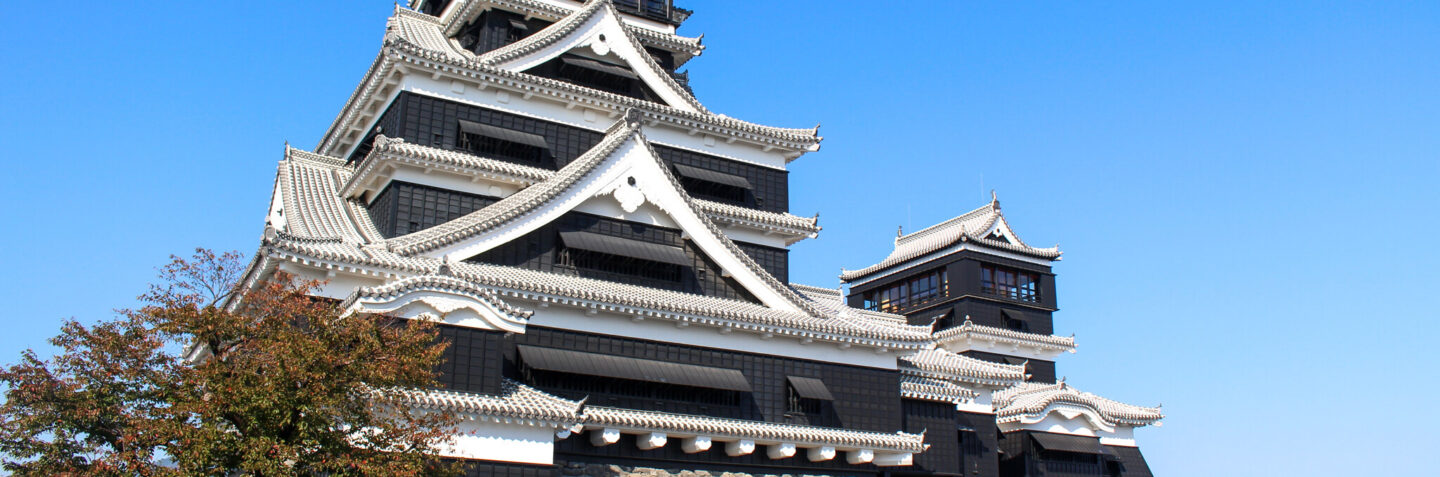

Prices and hours verified September 2026
Status, 14 September 2026. On 28 July 2026 a magnitude 7.1 earthquake struck the Kumamoto region, registering the maximum intensity 7 on Japan’s seismic scale. Seven weeks on, the picture for Kumamoto travel is uneven and worth stating plainly before anything else:
- Kumamoto City is open and reachable. The Kyushu Shinkansen is running.
- Kumamoto Castle reopened on 13 August, including access to the keep.
- Rail south of the city is still disrupted. The JR Kagoshima Line is suspended between Uto and Yatsushiro, with replacement buses.
- Aftershocks continue at above-normal levels, though gradually decreasing.
- Tourism collapsed over the summer, and that is now its own problem for the region.
So the honest answer to “should I go?” is yes, to the city, with your eyes open. And the honest answer to “is everything back to normal?” is no. Here is what is actually open, what is not, and what to see when you get there.
The Situation, Honestly
The 2026 earthquake hit a prefecture still finishing its recovery from the 2016 one. Kumamoto Castle had spent a decade being rebuilt; it took damage again.
The damage is not uniform, and that is the single most useful thing to understand. Kumamoto City has reopened its major sites. The corridor south of the city, Yatsushiro and beyond, is where the transport disruption remains, and several onsen towns in the affected areas are still dealing with damage. Treating “Kumamoto” as one condition will either put you off unnecessarily or send you somewhere you should not be.
The Japan Meteorological Agency continues to advise against entering dangerous or unstable areas, and notes that seismic activity remains above normal while gradually declining.
What is running and what is not, from the transport ministry’s status report of 9 September:
| Route | Status |
|---|---|
| Kyushu Shinkansen | Running, Kumamoto is reachable |
| JR Kagoshima Line, Uto to Yatsushiro | Suspended; replacement buses morning and evening |
| Kumamoto to Shin-Yatsushiro | Shinkansen substitute service from 18 September |
| Hisatsu Orange Railway, Yatsushiro to Higo-Tanoura | Suspended; replacement buses |
💡 Japan Pro Tip: On the Kumamoto to Shin-Yatsushiro substitute arrangement starting 18 September, ordinary tickets are honoured on the Shinkansen and no limited express supplement is required. If your route takes you south of Kumamoto, that is a meaningful saving and it is not obvious from the timetable. Check the current status the week you travel. This is changing month to month, not year to year.
Kumamoto Castle
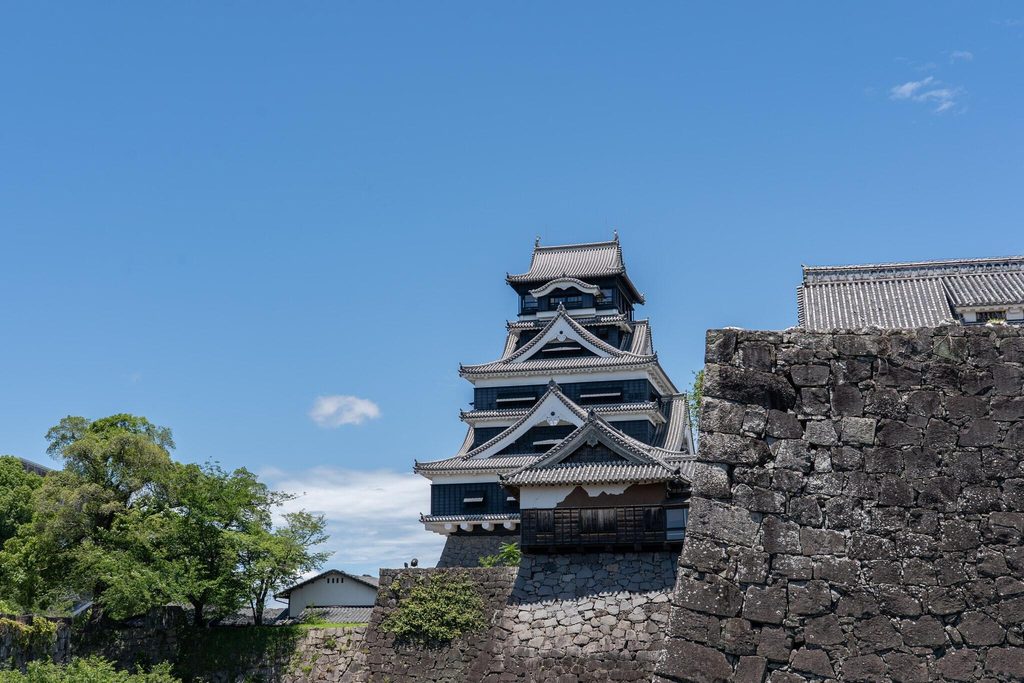
Japan’s great black fortress, and the emotional centre of the city. It reopened on 13 August 2026, sixteen days after the earthquake, with the keep interior accessible again. The mayor framed the early reopening explicitly as accelerating recovery.
- Where: central Kumamoto, reachable by tram from Kumamoto Station
- Last entry: 16:00
- Tickets: buy online in advance, as recommended on the castle’s own site
- Official site: Kumamoto Castle
The Ninomaru Plaza and Katō Shrine give you the exterior views without entering the paid area, and the special viewing walkway lets you see restoration work in progress.
💡 Japan Pro Tip: Last entry is 16:00, which is earlier than most visitors assume for a major castle and earlier than the site itself closes. Kumamoto’s other big sight, Reigandō, closes at 17:00 and is 30 minutes out of town, so you cannot do both in one afternoon. Castle in the morning, cave after lunch, or split them across two days.
Go and look at the restoration honestly rather than just photographing the keep. Watching a castle being rebuilt twice in a decade is a more interesting thing to witness than a finished building.
Reigandō Cave and the 500 Arhats
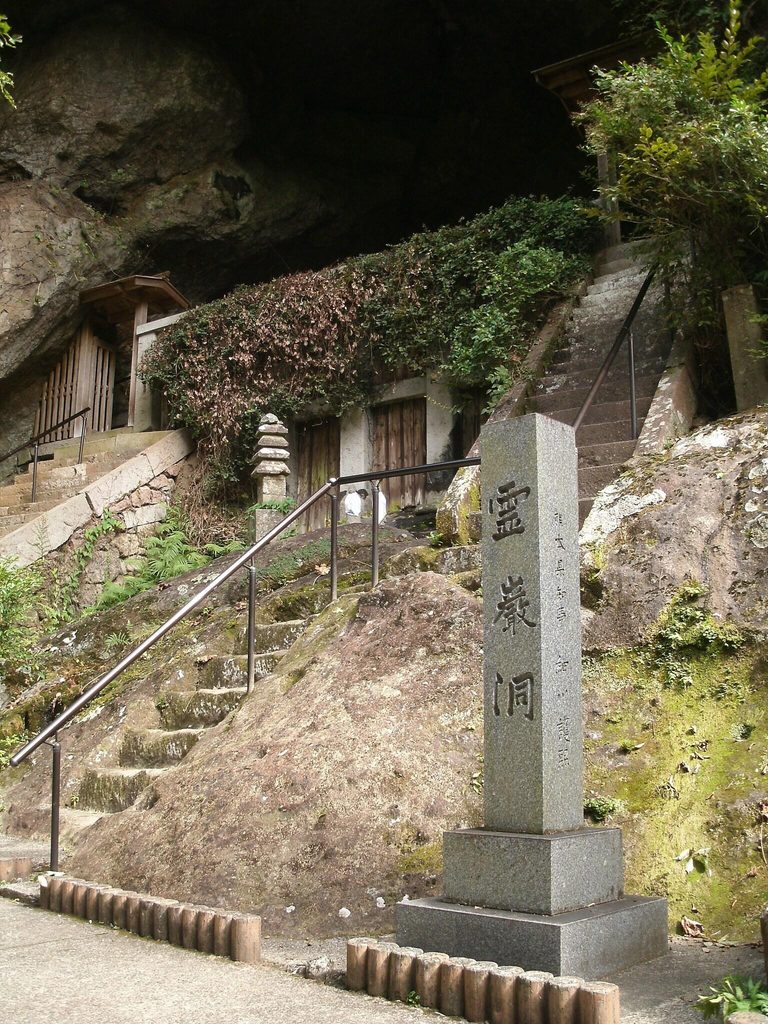
In the 1640s Miyamoto Musashi, Japan’s most famous swordsman, withdrew to a cave in the hills west of Kumamoto and wrote The Book of Five Rings, the treatise on strategy still read by martial artists and, improbably, business schools.
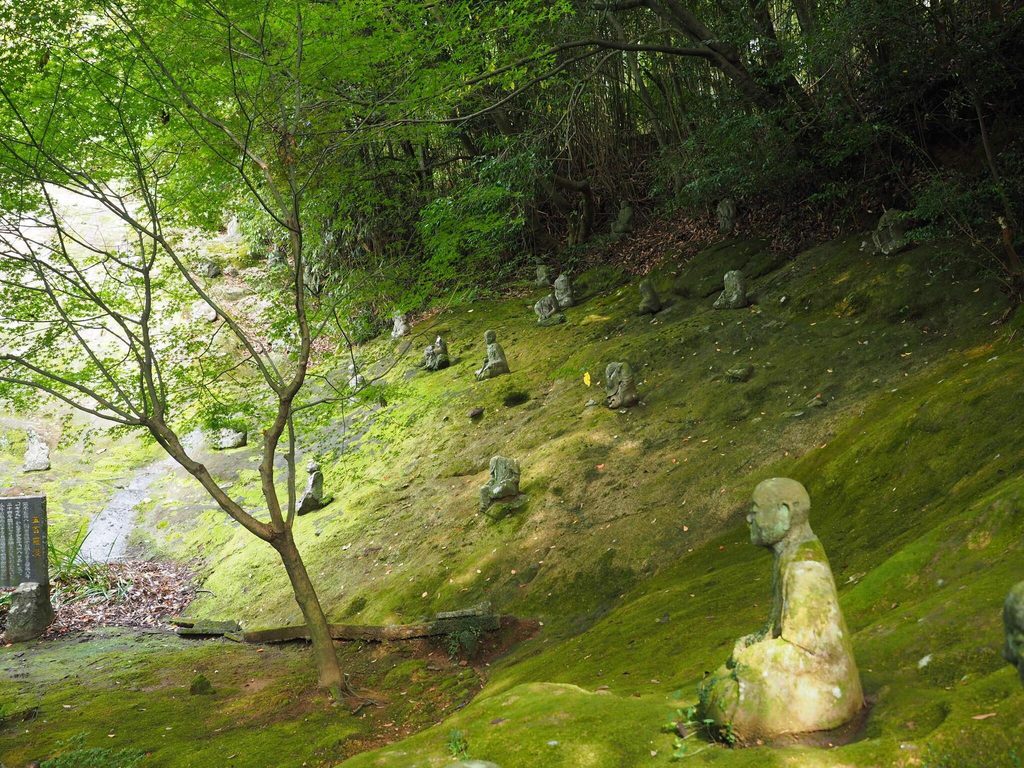
The cave, Reigandō, sits on the grounds of Unganzenji, a Zen temple founded in the 1300s. The approach is the part nobody prepares you for: a mossy stone path lined with hundreds of stone arhats, disciples of the Buddha, each with a different posture and expression, carved into the rock face. They were donated by a merchant over 24 years, roughly two centuries ago.
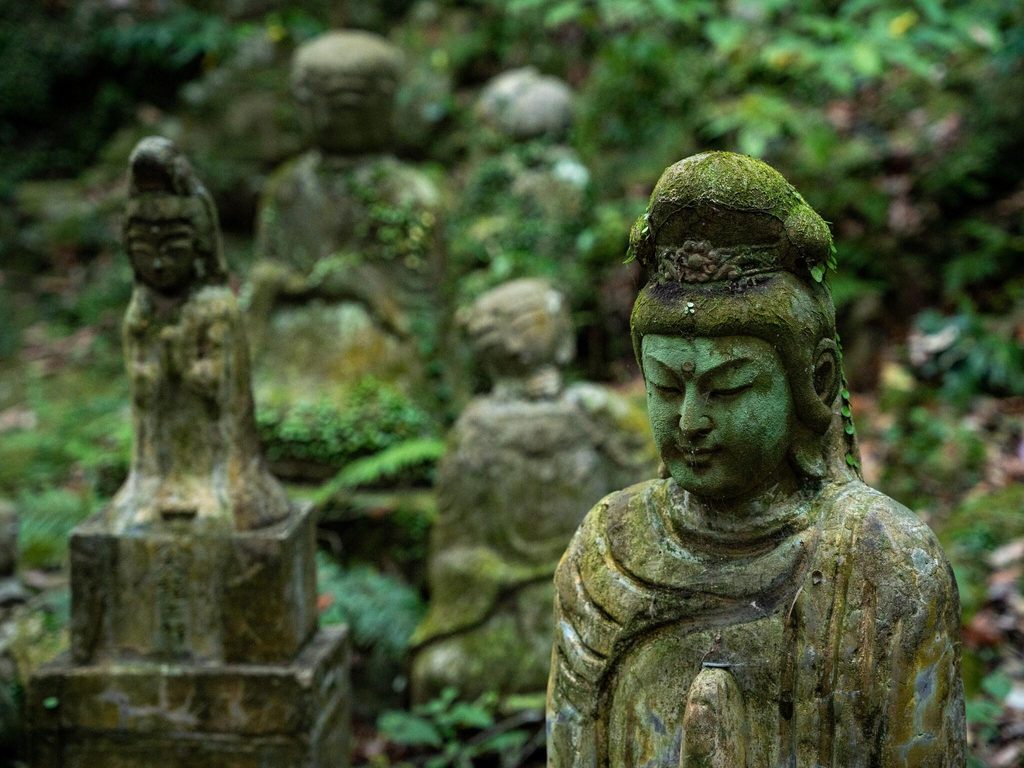
- Where: 589 Hirayama, Matsuo-machi, Nishi-ku, Kumamoto
- Hours: 08:00 to 17:00
- Prix : ¥300 adults, ¥200 high school, ¥100 middle school and under
- Comment y arriver : about 30 minutes by car from Kumamoto Station. By public transport, a Sankō bus from Sakuramachi Bus Terminal takes around 30 minutes to the Iwato Kannon Iriguchi stop, then it is about a 20-minute walk
- Official site: Kumamoto City tourism guide, Reigandō
💡 Japan Pro Tip: That 20-minute walk is the detail that catches people, and it is uphill on uneven ground. Nothing about “meditative cave, ¥300” suggests an hour of travel each way on a rural bus plus a climb. Budget half a day, wear real shoes, and check the return bus time before you set off. Services out here are not frequent. If there are two or more of you, a taxi from the city may cost less than you would think and saves the walk.
Training with Musashi’s 18th-Generation Successor
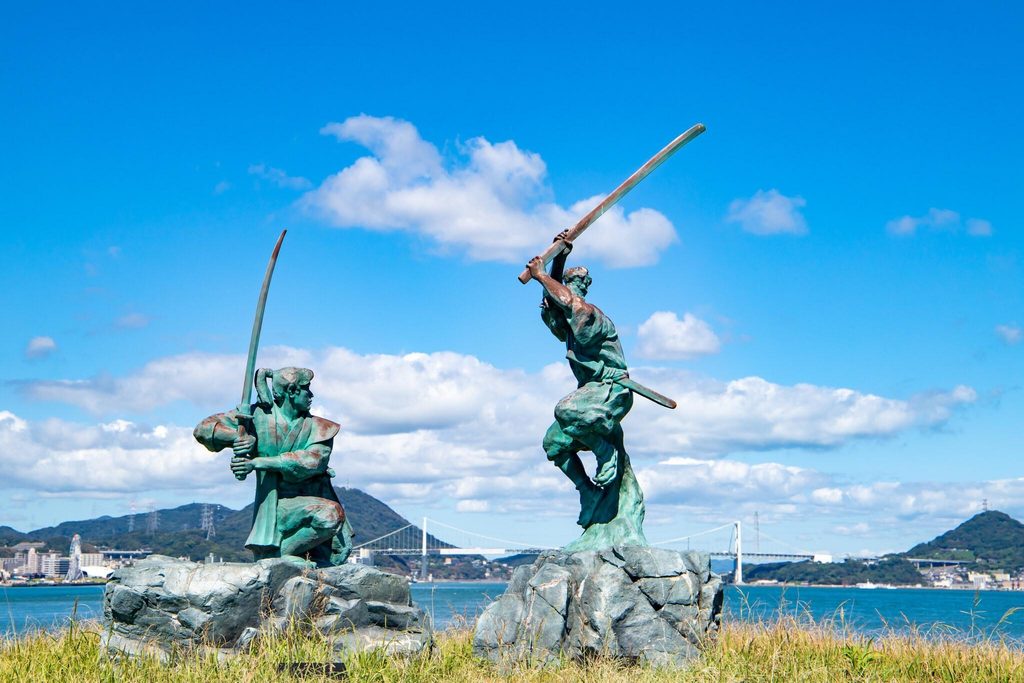
The experience that makes Kumamoto different from other castle towns: you can train with Akinori Matsunaga, the 18th-generation successor of Niten Ichi-ryū, the two-sword school Musashi himself founded.
That is an unbroken line of transmission from the man who wrote the book, in the city where he wrote it. Most samurai experiences in Japan are costumed photo sessions. This is a lineage school.
💡 Japan Pro Tip: Confirm booking arrangements directly before building a day around it. Sessions with a traditional school are not a walk-up attraction and availability is limited. The pairing is the point: read The Book of Five Rings, visit the cave where it was written, then hold the two swords it describes. Done in that order it is one of the better days available to a visitor in Japan.
Kumamoto Travel Basics: The Tram Pass and the Luggage Trick
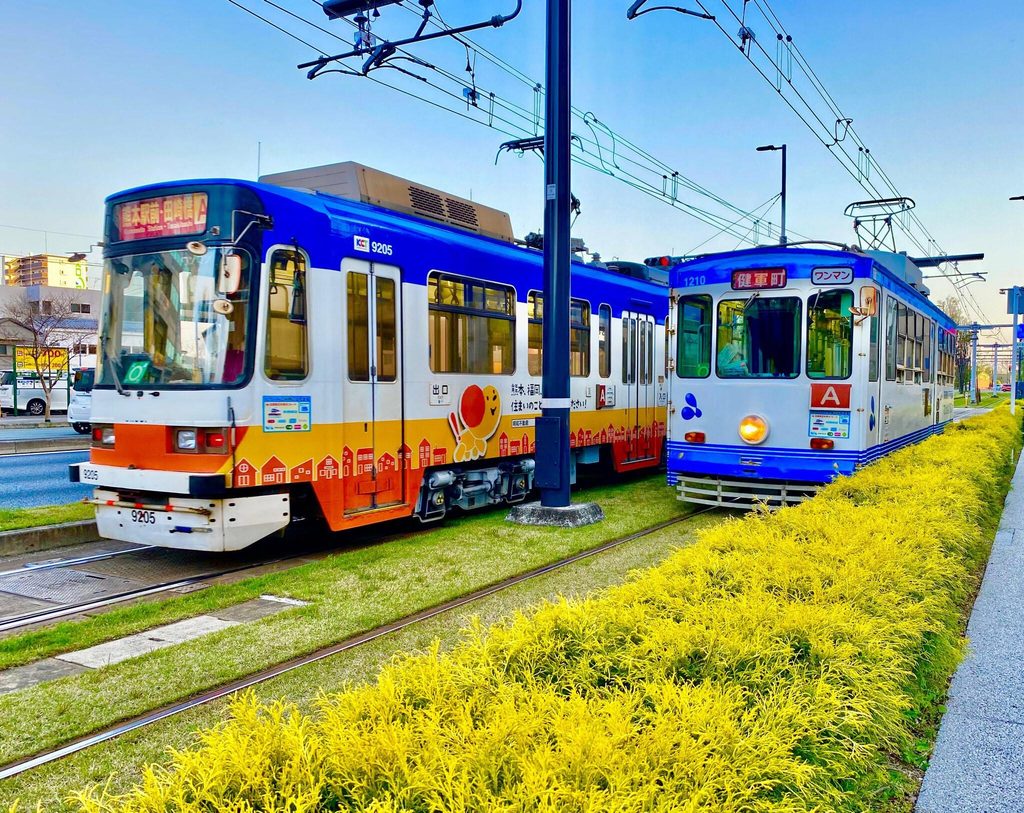
Kumamoto runs a tram network, and a one-day tram pass is available at Kumamoto Station.
There is also a combined option worth knowing about: a set sold online pairing luggage delivery with a 24-hour tram pass. Drop your bags at Kumamoto Station on arrival and have them forwarded to your hotel while you spend the day unencumbered.
💡 Japan Pro Tip: That luggage and tram combination is the single most useful thing in this article for anyone arriving by Shinkansen with a suitcase. Kumamoto Castle is not a place you want to be dragging a case around, and the walk at Reigandō makes it impossible. Confirm current pricing and the booking page before you travel, as these bundled services change.
Should You Go?
Yes, to Kumamoto City, with realistic expectations.
The case for going: tourism collapsed after the earthquake, with visitor numbers over the summer falling far below normal. For a region whose economy depends partly on visitors, that is a second wave of damage after the first. The castle reopened quickly and deliberately because the city wanted people back. Visitors who come, spend money and treat the place respectfully are helping.
The case for care: aftershocks continue. Transport south of the city is disrupted. Some facilities have changed hours or remain closed, and published information goes out of date fast.
What that means practically: check each place’s own website in the week you travel rather than relying on any article, including this one. Do not go looking for damage to photograph. And do not cancel a Kumamoto City trip on the assumption that the whole prefecture is closed, because it is not.
FAQ
Is it safe to travel to Kumamoto in 2026?
Kumamoto City has reopened its major sites and is reachable by Shinkansen. Seismic activity remains above normal levels while gradually declining, and the JMA advises avoiding unstable or dangerous areas. Transport south of the city towards Yatsushiro is still disrupted. Check official sources close to your travel date.
Is Kumamoto Castle open?
Yes. It reopened on 13 August 2026 following safety checks after the July earthquake, with access to the keep. Last entry is 16:00 and advance online tickets are recommended.
When was the 2026 Kumamoto earthquake?
28 July 2026 at 16:27, magnitude 7.1, registering the maximum intensity 7 on the Japanese seismic scale, with its epicentre in the Kumamoto region.
Can I get to Kumamoto by train?
Yes, the Kyushu Shinkansen is running. The JR Kagoshima Line is suspended between Uto and Yatsushiro with replacement buses, and from 18 September the Shinkansen provides substitute transport between Kumamoto and Shin-Yatsushiro with ordinary tickets honoured.
How do you get to Reigandō Cave?
About 30 minutes by car from Kumamoto Station, or a roughly 30-minute bus from Sakuramachi Bus Terminal to Iwato Kannon Iriguchi followed by a 20-minute walk. Open 08:00 to 17:00, ¥300 for adults.
Where did Miyamoto Musashi write The Book of Five Rings?
In Reigandō, a cave on the grounds of Unganzenji temple in the hills west of Kumamoto, in the 1640s. The temple dates from the 1300s and the approach is lined with hundreds of stone arhats carved over 24 years about two centuries ago.
Can you do Kumamoto Castle and Reigandō in one day?
Not comfortably. The castle’s last entry is 16:00 and Reigandō closes at 17:00 with an hour of travel each way. Do one in the morning and the other after lunch, or split them across two days.
Should I cancel my Kumamoto travel plans?
Not for the city, if your dates are after now and you check current conditions. If your itinerary runs south of Kumamoto towards Yatsushiro or into affected onsen areas, re-plan that section and confirm each facility directly.
Go, and Check Before You Go
Kumamoto is a city with a black castle, a cave where a swordsman wrote a book people still read four centuries later, and a living school that teaches what he taught. It has also just been through a major earthquake, and it would like visitors back.
Both of those things are true. Check the official sites the week you travel, then go. If Kyushu is one leg of a longer route, the Le meilleur moment pour visiter le Japon covers the year month by month, and the autumn foliage forecast has the 2026 dates by city.
Last verified: 14 September 2026, against JMA, the transport ministry’s 9 September status report, and each site’s official information.
Prêt à découvrir le Japon ?
Découvrez des séjours triés sur le volet, des expériences locales et des voyages guidés par des experts du Japon.
Explorer le Japon
 English
 Chinese (China)
 Chinese (Taiwan)
 Korean
 Thai
 French
 Spanish
 German
 Vietnamese
 Indonesian
 Italian